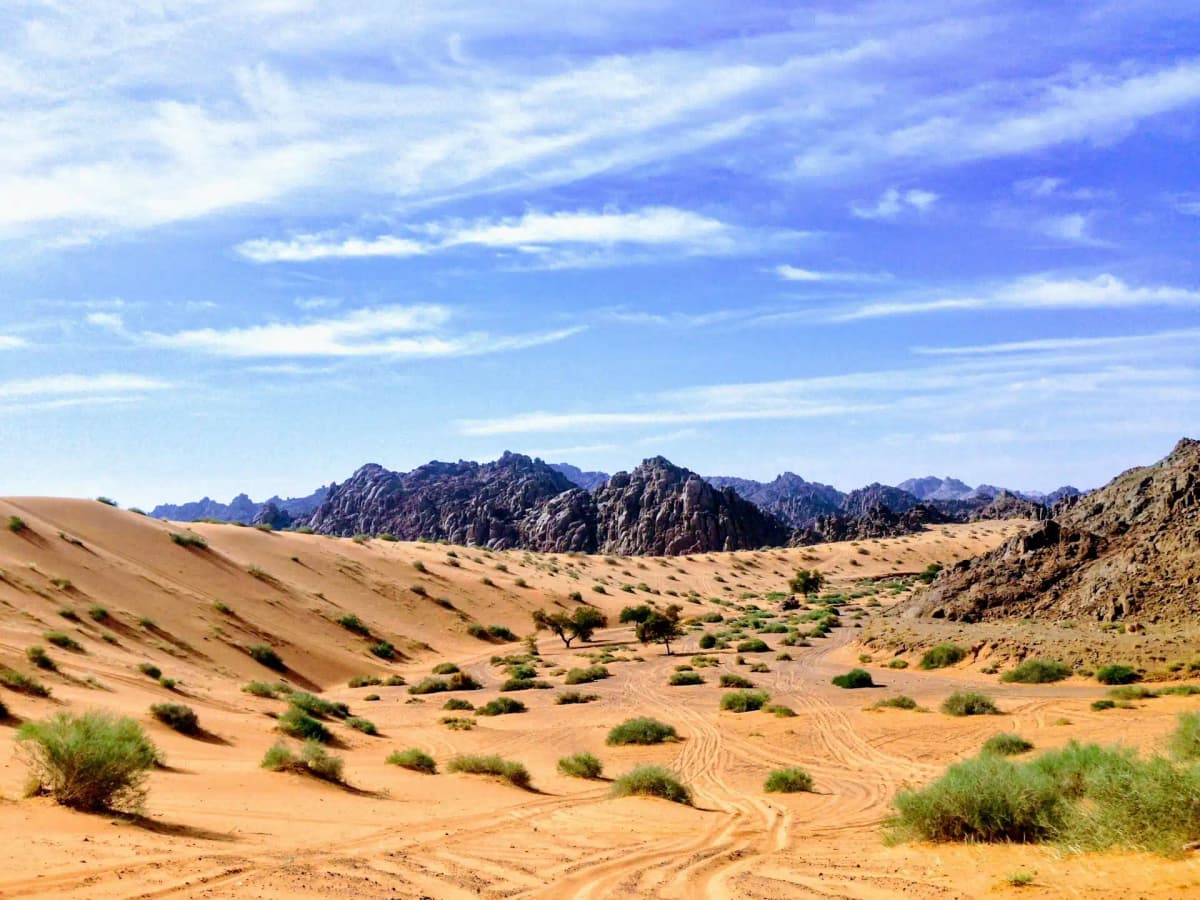
Key Summary- The vast majority of Saudi Arabia endures a parched hot desert climate (BWh), where summer temperatures stubbornly high and annual rainfall rarely exceeds a few millimetres.
- A ribbon of high humidity clings to the Red Sea and Arabian Gulf coasts, combining soaring heat with sticky, oppressive air for much of the year.
- The southwestern highlands around Abha break the desert mould, enjoying a subtropical highland climate (Cwa) with mild summers and a short but noticeable monsoon-influenced rainy season.
Saudi Arabia’s climate is defined by its position at the heart of the Arabian Peninsula, where vast sand seas and rocky plateaus sit under a relentless subtropical high-pressure belt. The most widespread zone is the hot desert climate (BWh), which covers the interior including the Rub’ al Khali (Empty Quarter), the Najd plateau, and the northern borders. In these regions, summer daytime temperatures regularly soar to 40°C to 48°C (104°F to 118°F), while winter nights can dip to a surprisingly crisp 5°C to 12°C (41°F to 54°F), especially in the north near Al Jawf and Tabuk. Rainfall is negligible, arriving in erratic winter or spring bursts, and dust storms are a common feature when shamal winds sweep across the open terrain. The only meaningful deviation occurs in the southwest, where the Asir Mountains intercept moisture-laden air from the Indian Ocean. Here, pockets of a semi-arid climate (BSh) and even a subtropical highland climate (Cwa) allow modest annual rainfall between 200 mm and 500 mm (8 to 20 inches), concentrated in the summer months and nurturing terraced hillsides and juniper woodlands that feel a world away from the dunes below.
Geography sharpens the climate into several distinct experiences. The Red Sea coastal plain, known as Tihamah, bakes under BWh conditions but adds dense marine humidity, making places like Jeddah feel like a steam bath from June through September, when overnight temperatures often stay above 30°C (86°F). Moving east to the Arabian Gulf, cities such as Dammam and Al Khobar endure a similar combination of searing heat and stifling moisture, though winter delivers a narrow window of balmy, pleasant air. Inland, Riyadh lies on the Najd plateau at around 600 metres (2,000 feet), which trims a few degrees from the peak summer extremes but still sees the mercury pulse well past 43°C (109°F) in July and August. The real relief is found in the cooler highlands of the southwest. Abha and Khamis Mushait, perched above 2,000 metres (6,500 feet), enjoy daytime highs of 25°C to 30°C (77°F to 86°F) in summer and cool nights year-round, with July and August bringing a burst of cloud and convective showers that paint the landscape in surprising green. This cool-island effect makes the Asir region extraordinarily popular with domestic tourists escaping the lowland furnace.
For travellers, timing is everything. The broad optimal travel window runs from November to February, when daytime temperatures in the deserts and cities settle into a comfortable 20°C to 30°C (68°F to 86°F) range, and evenings are cool enough for a light jacket or shawl. This is the ideal stretch for exploring the archaeological wonders of AlUla, camping under dazzlingly clear desert skies, or strolling the corniche in Jeddah without the weight of summer humidity. Late spring and early autumn (March to April, October) can still be manageable, but by May the heat begins its fierce ascent, and from June to September lowland areas become punishingly hot and muggy, making outdoor sightseeing during midday inadvisable. If you must visit in summer, heading straight to the Asir highlands offers a completely different climate — one where you might actually need a raincoat for the afternoon showers of Abha. Packing reflects the contrasts: lightweight, loose-fitting fabrics, broad-brimmed hats, and strong sun protection are non-negotiable year-round, while a warmer mid-layer is essential for winter evenings in the desert and the air-conditioned chill of shopping malls. Whether you are tracking the cool winter sun or escaping to the monsoon-freshened mountains, Saudi Arabia’s climate is a story of extremes softened by a few surprising refuges. Explore our detailed monthly charts and climate maps on WeatherBox to plan your visit around the weather that suits you best.